
Budgeting OnlyFans Around Failed Card Charges
Any subscription on OnlyFans renews on the date the creator set when you first joined. That date is not fixed to a calendar slot you chose. It follows the page, and it changes the moment a payment fails and a retry later succeeds.

A declined card does not cancel the subscription. It pauses the renewal until the charge clears, and the clearing date becomes the new anniversary. Subscribers who track only a monthly total often miss this shift until two charges arrive in the same period.
How a failure moves your billing date
When a renewal charge is declined, the platform retries. Each retry that fails pushes the successful charge further out. Once a payment finally clears, that clearing date becomes the new renewal date for every future cycle on that page.
This is not a skipped month and it is not a free extension. The subscription cost stays the same, but the period you paid for now starts later. Over a few months, a single failure can move a renewal from the start of the month to the middle of it.
If several pages fail around the same time, their dates drift together. That clustering is the real budgeting problem. The amount owed does not rise, but the timing does, and timing decides whether a card balance holds.

Stacked charge scenarios
A failed charge is rarely a single event. It interacts with the rest of your subscriptions, and the collision appears a few weeks later as a heavier billing window. The list below covers the situations that produce stacking most often.
- A retry clears three days after payday, so the charge lands in the next budget cycle instead.
- Two pages fail in the same week and both retries clear within days of each other.
- A promotional first month ends while a retry is still pending, so the standard rate applies immediately after.
- A tip or pay-per-view message is opened during the gap, adding a separate charge on top of the renewal.
- A card replacement forces a manual update, and the new date settles near an existing renewal.
Each case produces the same effect: two charges inside one month for pages that used to bill a month apart. Nothing about the price changed. Only the calendar did.

Cost stacking table
The table compares a stable month with a month disrupted by one declined renewal. The pages are identical in both examples, and the only variable is timing.
| Page | Normal month | Post-failure month |
|---|---|---|
| Page A | $4.99 on the 3rd | $4.99 on the 3rd |
| Page B | $9.99 on the 12th | $9.99 on the 19th |
| Page C | $6.99 on the 21st | $6.99 on the 19th |
| Page D | $14.99 on the 27th | $14.99 on the 27th |
| Monthly total | $36.96 across four weeks | $36.96 in one 11-day window |
The total is unchanged, yet the post-failure month concentrates most of it into a short stretch. That is the pattern a monthly budget has to absorb, and it is easier to plan for once the new dates are written down.

Rebuilding the monthly plan
Once the shifted dates are known, the goal is separation. You want renewals spread across the month rather than grouped into one week. Cancelling and rejoining a page sets a fresh date, though it also resets your access to that page’s history, so use it sparingly.
Paid subscription prices sit between $4.99 and $49.99 across the platform. Most paid pages fall in the $4.99 to $15 range, with averages around $5 to $10. There is no base price below $4.99, and only a promotional first month may dip lower.
Free pages are different. A free page is simply a price set to $0, and the creator earns through pay-per-view messages and tips instead. Those charges are not renewals, so they do not move a billing date, but they still land on the same card and compete for the same balance.
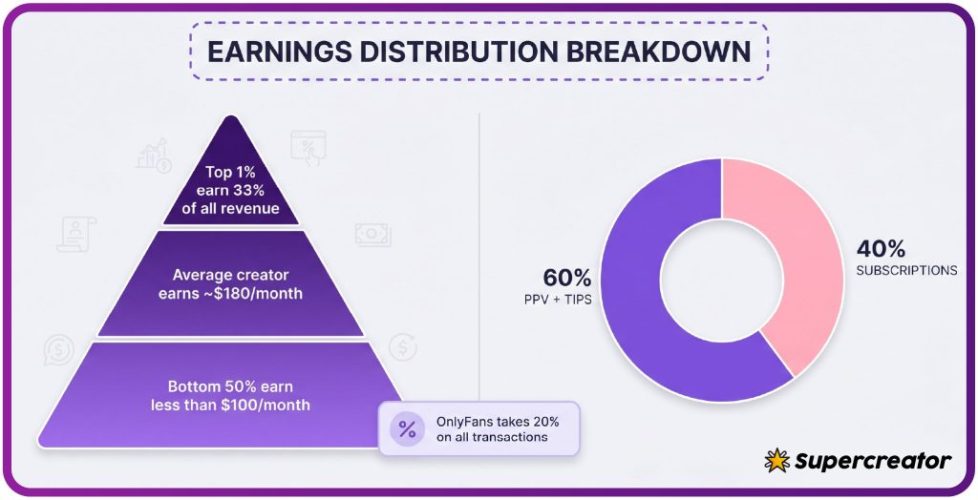
- Platform fees apply to everything at 20%, covering subscriptions, tips and pay-per-view.
- The creator keeps 80%.
- That fee does not change your total, but it explains why pricing pages set their own tiers rather than a single flat rate.
Practical tip: after any failed charge clears, write the new renewal date next to that page before the month ends. A date you record on the day it changes is far easier to budget than one you reconstruct from a statement later.
Because the platform has no built-in discovery feed or directory, most subscribers find pages through ranking services that compare public profile details. BestOnlyFans is one example, listing pages by price, promotions, posting activity and media counts. A second such service, Best Only Fans Rankings, groups pages the same way so a reader can compare before joining. A third, Top Free Only Fans, focuses only on free pages, where the price is $0 and support happens through tips and paid messages. A practical starting point is best onlyfans fee explainers, which lists pages by the signals above.
The month-by-month costs to expect after rebuilding a schedule look like this:
- Month one: one larger cluster while the shifted dates settle into place.
- Month two: charges begin to separate as the new dates hold.
- Month three: a more even spread across the four weeks.
- Month four onward: the total stays level and the timing stabilises.
For a wider explanation of how fees and renewals interact across different page types, the guides collected as the best onlyfans fee explainers walk through the same mechanics in more detail.

The buffer approach
A buffer is a small reserve kept on the card or in the account specifically for retries, temporary holds and duplicate charges. It does not need to cover a full month of subscriptions, only the overlap that a failed charge can create.
Most banks place a temporary hold when a charge is declined and retried. The hold usually clears on its own, but it reduces the available limit in the meantime, which is why a successful retry can still be followed by a second decline on a different page.
The mistakes below are the ones that turn a single failure into a month of problems:
- Assuming a declined charge means the subscription ended, and cancelling it manually as well.
- Ignoring the temporary hold and letting the next renewal attempt draw on the same balance.
- Adding a new page during the gap, when the shifted dates are still unknown.
- Deleting the card on file instead of updating it, which interrupts every page at once.
- Relying on the old renewal date after a retry has already moved it.

Spotting a double charge
A double charge is not always an error. Two charges can appear legitimately when a shifted renewal lands beside an unchanged one. Distinguishing a real duplicate from a stacked month starts with reading the statement carefully.
The signs that you were billed twice for the same page include:
- Two identical amounts from the same page inside one billing period.
- A pending amount and a completed amount for the same page on the same day.
- A charge dated before the new renewal date you recorded after a retry cleared.
- A tip or message charge that carries the same amount as the subscription by coincidence.
- A bank hold that stays past its normal clearing window.
If two identical charges are confirmed, the correct first step is to contact the platform’s support and the card issuer with both transaction references. Do not delete the card on file, because that interrupts every other page and makes the record harder to reconcile.
When to trim pages instead
A failed charge is a natural review point. If a page sat unopened for the whole period before the decline, the subscription is not earning its place in the budget, and the failure simply surfaced that earlier.
Trimming is not the same as cancelling everything.
Card payments clear through a processor, so a stuck charge is usually an authorisation hold.
Recovery timeline table
After a declined renewal clears, the sequence below is what a subscriber can generally expect week by week.
| Week | What happens | What to do |
|---|---|---|
| Week 1 | Charge declines and the platform begins retries | Check the balance and hold the buffer in place |
| Week 2 | A retry clears and the renewal date shifts | Record the new date next to the page |
| Week 3 | A temporary bank hold may still reduce the limit | Delay any new page until the hold releases |
| Week 4 | Other renewals land against the shifted date | Compare the statement against your tracker |
| Week 5 | Dates separate as the new cycle holds | Trim any page left unopened |
The chart below shows how subscriber numbers have grown across the platform, which is the context behind why so many pages carry different price tiers and renewal dates.
BestOnlyFans lists pages by observable signals, not by volume. BestOnlyFans refreshes its rankings every month.
FAQ
Does a failed card charge cancel my subscription?
No.
Why did two charges arrive in the same month?
A retry shifted one renewal closer to another page’s date, so two normal charges landed inside one billing window instead of a month apart.
What happens if a creator raises the price during a retry?
Auto-renew stops when the price changes, and existing access lasts until the current paid period ends, so no new charge applies.
Is a free page affected by a failed charge?
A free page costs $0, so there is no renewal to decline, though tips and pay-per-view messages still draw on the same card.